🥛 Plant-Milk Makers
Best oat milk makers UK 2026: four machines tested against the carton
Almond Cow, Nutr and Milky Plant compared on cost per litre, texture in coffee and cleaning time — plus the £8 alternative that beats all three.
Some links on this page are affiliate links. If you buy through them we may earn a commission at no extra cost to you — it is what pays for the testing. How this works.
At a glance — full write-ups below.
| Product | Almond Cow Milk Maker Best overall | Nutr Machine Best for small kitchens | Milky Plant Best design |
|---|---|---|---|
| Our score | 9 /10 | 8.5 /10 | 8 /10 |
| Price | £219 | £169 | £199 |
| Batch size | Up to 1.4 L | ~300–500 ml | ~1 L |
| Method | Cold blend, steel filter basket | Heated or cold blend, fine mesh filter | Blend with automatic pulp ejection |
| Cycle time | ~60 seconds | ~2–10 minutes depending on mode | ~5 minutes |
| Hands-on time | ~2½ min per litre, start to clean | ~2 min per run, so ~5 min per litre | ~2 min per litre — the drawer is the win |
| Cleaning | Dishwasher-safe pitcher and basket | Self-clean cycle plus hand rinse | Removable pulp drawer, rinse cycle |
| Cost per litre (oats) | ~35–45p | ~40–55p | ~35–45p |
| Best for | Households drinking a litre or more a week who want the lowest cost per litre and the least fuss. | One or two people, limited worktop, and anyone who wants warm milk without a steam wand. | People who will only keep the habit up if cleaning takes ten seconds rather than two minutes. |
| Where to buy | Check price | Check price | Check price |
Oat milk is the most expensive thing in your coffee. A barista carton is around £2 a litre in the UK, and the ingredients in it come to something like 40p — oats, water, a splash of rapeseed oil and a pinch of salt. The rest is manufacturing, packaging, distribution and brand.
A plant-milk maker closes that gap. It is also, for a lot of people, £200 of appliance that gets used enthusiastically for a month and then lives in a cupboard. This guide is about which side of that line you are likely to fall on, and which machine to buy if you land on the good side.
The quick answer
Almond Cow for most households. It is a cold-blend machine, and cold blending is the single most important design decision in this category: heat gelatinises oat starch, which is what turns homemade oat milk into wallpaper paste. Big batches, dishwasher-safe parts, and you can buy every component separately when something breaks.
Nutr if you live somewhere small. It is the only machine here that genuinely fits in a cupboard, and the heated cycle with a delayed-start timer means warm milk waiting for you at breakfast without a steam wand in the house.
Milky Plant if the cleaning is what will beat you. It ejects the pulp into its own drawer as it works, so you finish with a jug of milk and a dry puck rather than a filter basket to scrape.
A blender and a nut-milk bag if you have not done this before. Forty seconds of blending and a squeeze through a fine bag makes milk indistinguishable from any machine here. What you are buying with a machine is the removal of the straining step — so find out first whether the straining step is what stops you.
The machines
No. 1 Best overall
Almond Cow Milk Maker
The workhorse. Cold-blend, big batch, endlessly repairable.

A cold-blend machine with a stainless steel filter basket that sits inside a 1.4 litre pitcher. It does not heat the oats, which is exactly why its oat milk stays clean rather than turning to wallpaper paste — heat is what gelatinises oat starch. Batches are large, the parts are dishwasher-safe, and almost every component can be bought individually if you break one.
What works
- Cold blending keeps oat milk thin and pourable rather than slimy
- Largest usable batch size here — a full 1.4 L in about a minute
- Every part is sold separately, so a cracked pitcher is not a dead machine
- Handles nuts, seeds and soy just as well as oats
What doesn't
- Bulky: it wants a permanent worktop spot, not a cupboard
- The filter basket needs rinsing immediately or the pulp welds itself on
- No built-in heating, so no warm milk straight from the jug
- Batch size
- Up to 1.4 L
- Method
- Cold blend, steel filter basket
- Cycle time
- ~60 seconds
- Hands-on time
- ~2½ min per litre, start to clean
- Cleaning
- Dishwasher-safe pitcher and basket
- Cost per litre (oats)
- ~35–45p
Buy it if: Households drinking a litre or more a week who want the lowest cost per litre and the least fuss.
No. 2 Best for small kitchens
Nutr Machine
Single-serve, heated, and small enough to live next to the kettle.
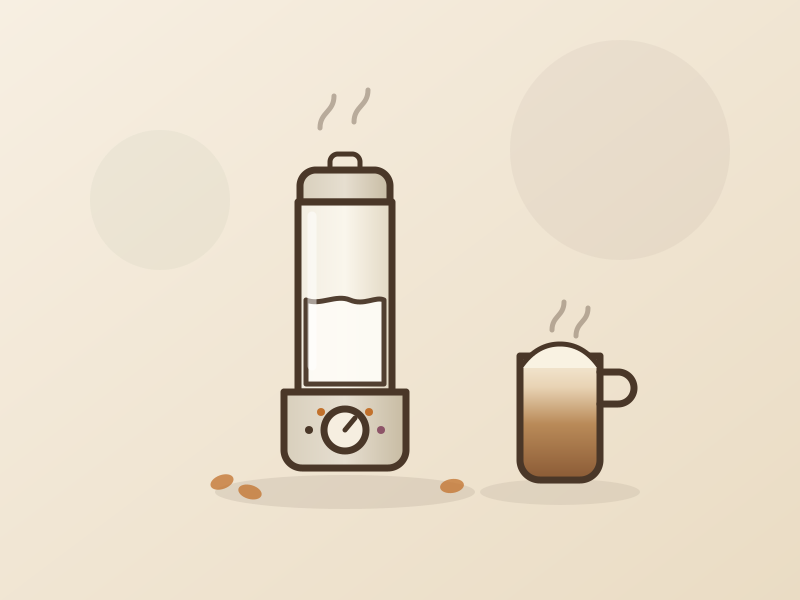
A compact machine that makes roughly one to two cups at a time with four temperature settings, including a warm mode that delivers milk ready for a latte. The footprint is the headline: it is about the size of a large travel mug, which makes it the only realistic option in a small flat. The trade-off is batch size and the heated cycle, which needs a little technique to avoid thick oat milk.
What works
- Tiny footprint — genuinely fits in a cupboard
- Heated cycle gives warm milk with no separate pan or steam wand
- Very quick to rinse; fewer parts than the big cold-blend machines
- Delayed-start timer means milk waiting for you in the morning
What doesn't
- Small batches: you will run it two or three times for a family
- The hot cycle can thicken oat milk if you over-blend — use the cold setting for oats
- Higher cost per litre than a big-batch machine once you count run time
- Batch size
- ~300–500 ml
- Method
- Heated or cold blend, fine mesh filter
- Cycle time
- ~2–10 minutes depending on mode
- Hands-on time
- ~2 min per run, so ~5 min per litre
- Cleaning
- Self-clean cycle plus hand rinse
- Cost per litre (oats)
- ~40–55p
Buy it if: One or two people, limited worktop, and anyone who wants warm milk without a steam wand.
No. 3 Best design
Milky Plant
The one you leave out on purpose. Self-separating pulp drawer.
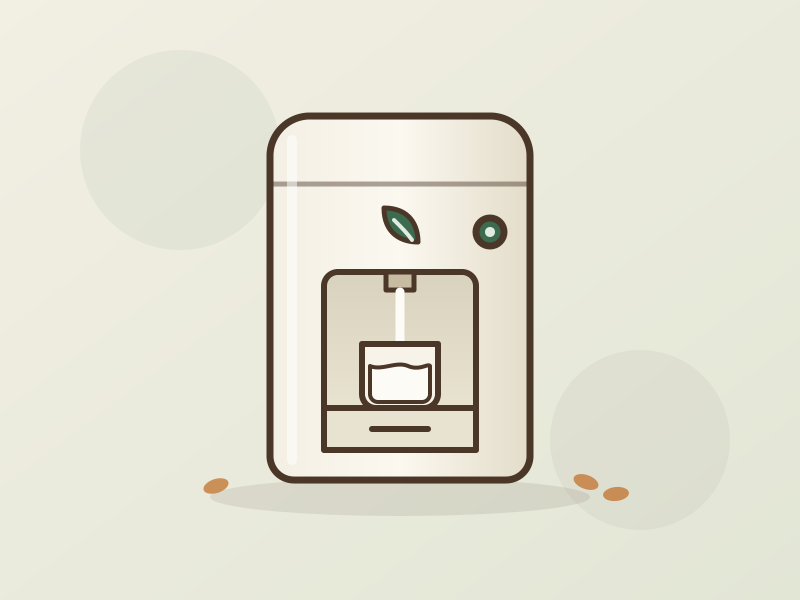
The prettiest machine in the category and the only one that ejects the pulp into its own drawer as it works, so you finish with a jug of milk and a puck of oat pulp rather than a filter to scrape. It is a genuinely clever bit of engineering and the reason people forgive its smaller batch size and premium price.
What works
- Automatic pulp separation — by far the least unpleasant cleanup
- Looks like a kitchen appliance you would leave on display
- One-touch operation with no filter bag to wrestle
- Pulp comes out dry enough to bake with straight away
What doesn't
- Smaller batch than the Almond Cow for a similar price
- More moving parts than a filter-basket machine
- Direct-only availability means slower support if something fails
- Batch size
- ~1 L
- Method
- Blend with automatic pulp ejection
- Cycle time
- ~5 minutes
- Hands-on time
- ~2 min per litre — the drawer is the win
- Cleaning
- Removable pulp drawer, rinse cycle
- Cost per litre (oats)
- ~35–45p
Buy it if: People who will only keep the habit up if cleaning takes ten seconds rather than two minutes.
No. 4 Best budget route
A high-speed blender + nut milk bag
The honest control option. Worse ergonomics, same milk.

You do not need a milk maker to make oat milk. Forty seconds in any decent blender and a squeeze through a fine bag produces milk that is indistinguishable from a £200 machine. What you are actually buying with a machine is the removal of the washing-up step — which is precisely the step that makes people quit after three weeks.
What works
- Cheapest possible entry if you already own a blender
- Total control over ratio, soak time and additions
- Nothing extra to store on the worktop
What doesn't
- Straining and wringing the bag is genuinely tedious
- Easy to over-blend and produce slimy milk
- Bags stain, smell and eventually need replacing
- Batch size
- Whatever your jug holds
- Method
- Blend and hand-strain
- Cycle time
- ~40 seconds blending, 3 minutes straining
- Hands-on time
- ~6 min per litre — nearly all of it yours
- Cleaning
- Hand wash, and the bag needs care
- Cost per litre (oats)
- ~30–40p
Buy it if: Trying the habit before spending £200 — and finding out whether you actually stick with it.
How to choose between them
Start with how much you actually drink
This is the only question that matters financially. Write down how many litres of oat milk your household gets through in a week — check the recycling if you are not sure.
- Under 1 litre a week. Do not buy a machine. You will spend £200 to save about £80 a year, and the payback sits beyond the point where most people lose interest.
- 1–3 litres a week. A machine makes sense, and batch size is the deciding factor. The Almond Cow’s 1.4 litres means two runs a week rather than six.
- 3+ litres a week. Buy the biggest batch you can and treat the machine as infrastructure. The Almond Cow, again.
Then decide what will make you stop
Every failed kitchen appliance fails for the same reason: a small friction repeated daily. In this category there are exactly three, and each machine is designed around removing a different one.
| The friction | The machine that removes it |
|---|---|
| Scraping wet pulp out of a filter | Milky Plant (automatic pulp drawer) |
| No worktop space to leave it out | Nutr (roughly the size of a large travel mug) |
| Running it three times to fill a bottle | Almond Cow (1.4 L in one go) |
Be honest about which of those is yours. It is a better predictor of whether you will still be making oat milk in a year than any spec on the box.
Heat is the enemy
Oat starch gelatinises somewhere around 55–65 °C. That is why hot-blend machines — and any recipe that tells you to soak oats in warm water — produce thick, slippery milk that ruins a flat white.
If you buy a machine with a heated cycle, use the cold setting for oats and heat the milk afterwards. The Nutr’s warm mode is genuinely useful for a morning latte, but run oats cold and warm the finished milk if you find your results thickening.
The recipe that works in all of them
- 80 g rolled oats (not instant, not steel-cut) to 1 litre of cold water
- 1 tsp neutral oil — rapeseed or sunflower — if the milk is for coffee
- A pinch of salt, and a date or a teaspoon of maple syrup if you drink it in cereal
Blend cold, briefly. Strain if your machine does not. Chill before drinking; it tastes noticeably better cold and settles in texture after an hour in the fridge.
That is 8p of oats and about 3p of oil per litre at UK supermarket prices — call it 40p a litre after electricity and the occasional batch you pour away.
How long does it actually take?
The question nobody answers honestly, because the answer decides whether you are still doing this in six months. Here is a real litre on the Almond Cow, timed:
| Step | Time | Hands-on? |
|---|---|---|
| Weigh 80 g of oats, fill the pitcher with cold water | 30 sec | Yes |
| Blend cycle | 60 sec | No — walk away |
| Pour into a bottle, put it in the fridge | 20 sec | Yes |
| Rinse the filter basket and pitcher | 60–90 sec | Yes |
| Total | 3–4 minutes | ~2½ minutes of it yours |
The steps themselves come to just over three minutes; we round to four because real mornings include finding the bottle, spilling some oats and answering someone. Two and a half minutes of actual attention is the number to hold in your head — roughly the same as making a cafetière of coffee, and rather less than the round trip to the shop for a carton.
Per week, which is what matters
Two lattes a day is about 1.6 litres a week. Milk keeps three to four days, so you are making two batches:
| Machine | Batches per week | Hands-on per week | Per year |
|---|---|---|---|
| Almond Cow | 2 | ~5 min | ~4½ hours |
| Milky Plant | 2 | ~4 min | ~3½ hours |
| Nutr | 4–5 | ~10 min | ~9 hours |
| Blender + nut-milk bag | 2 | ~12 min | ~10 hours |
That is the real difference between these machines. Not milk quality — time. The Milky Plant’s pulp drawer and the Almond Cow’s batch size are both buying back the same thing from different directions, and the nut-milk bag is where all of it goes, which is exactly why most people who start with a bag stop within a month.
What it is not
It is not a weekend project. There is no soaking (soaking is actively wrong for oats — it makes the milk slimy), no cooking, no cheesecloth, and no overnight anything. If a recipe tells you to soak oats for eight hours, it was written for almonds and copied carelessly.
What is not in it
Cost is the headline reason people buy a machine. The ingredients list is the reason a lot of them keep using it.
A barista carton is water, oats, rapeseed oil, an acidity regulator, added minerals and vitamins, and salt. Nothing sinister — every item is doing a job. But two things are worth knowing:
- The sugar is made, not added. Commercial oat drinks use enzymes to break oat starch into simpler sugars, mostly maltose. That is what makes them sweet and creamy, and it is why a carton lists roughly 4 g of sugars per 100 ml with no sugar on the ingredients list. Homemade oat milk skips that step entirely and comes in under 1 g.
- Cartons are fortified and homemade is not. Calcium, iodine, B12, riboflavin and vitamin D are all added to the carton and are all absent from a jug of blended oats. If oat milk is replacing dairy in your diet, that gap needs a plan.
Both sides of that trade are covered properly in is homemade oat milk healthier? — including who should carry on buying fortified cartons regardless of what machine they own.
Where the money actually goes
A machine at £200 against cartons at £2 a litre pays for itself at roughly 125 litres. Two lattes a day is about 1.6 litres a week, so around eighteen months. Three years in, you are up by roughly £300.
That is a real return, but it is not fast, and it assumes you keep using it. Our full breakdown — including the electricity, the oats, and the honest cost of the first fortnight while you get the ratio right — is in is a milk maker worth it?.
What we would tell a friend
If you drink oat lattes every day and have the worktop space, buy the Almond Cow and a £12 thermometer, and you are done for a decade.
If you are curious but not committed, buy a nut-milk bag this week. If you are still making oat milk in a month, upgrade with confidence — and you will know exactly which friction you are paying to remove.
Common questions
How long does it take to make oat milk at home?
About four minutes for a litre from start to clean machine, of which roughly two and a half minutes need you standing there — 30 seconds to load, a 60-second blend you can walk away from, 20 seconds to bottle it, and 60–90 seconds of rinsing. At two lattes a day you will make two batches a week, so around five minutes a week in total.
Do you have to soak the oats first?
No — and you should not. Oats hydrate in seconds, and soaking them makes the starch far more available, which is the direct cause of slimy homemade oat milk. Use dry rolled oats straight from the bag.
Can you froth homemade oat milk?
Yes, but it will not behave like Oatly Barista out of the box. Commercial barista milks add rapeseed oil and an acidity regulator. Add a teaspoon of neutral oil per litre and a pinch of salt and homemade oat milk foams respectably; without them it will foam thinly and drop fast.
How long does homemade oat milk keep?
Three to four days in a sealed bottle in the fridge, and it will separate — that is normal, shake it. There are no preservatives in it, so treat it like fresh juice rather than like a carton.
Is a milk maker actually cheaper than buying cartons?
Yes, eventually. Homemade oat milk costs roughly 40p a litre against about £2 for a barista carton. A £200 machine breaks even at around 125 litres, which is 18 months at two lattes a day. If you drink less than a litre a week, buy cartons.
The Oat Note
One useful email a month
Sign-ups aren't open yet. Until they are, the RSS feed carries every new review and guide, or email us and we'll tell you when the first issue goes out.
We only email about oat milk and coffee gear. See our privacy notice.